
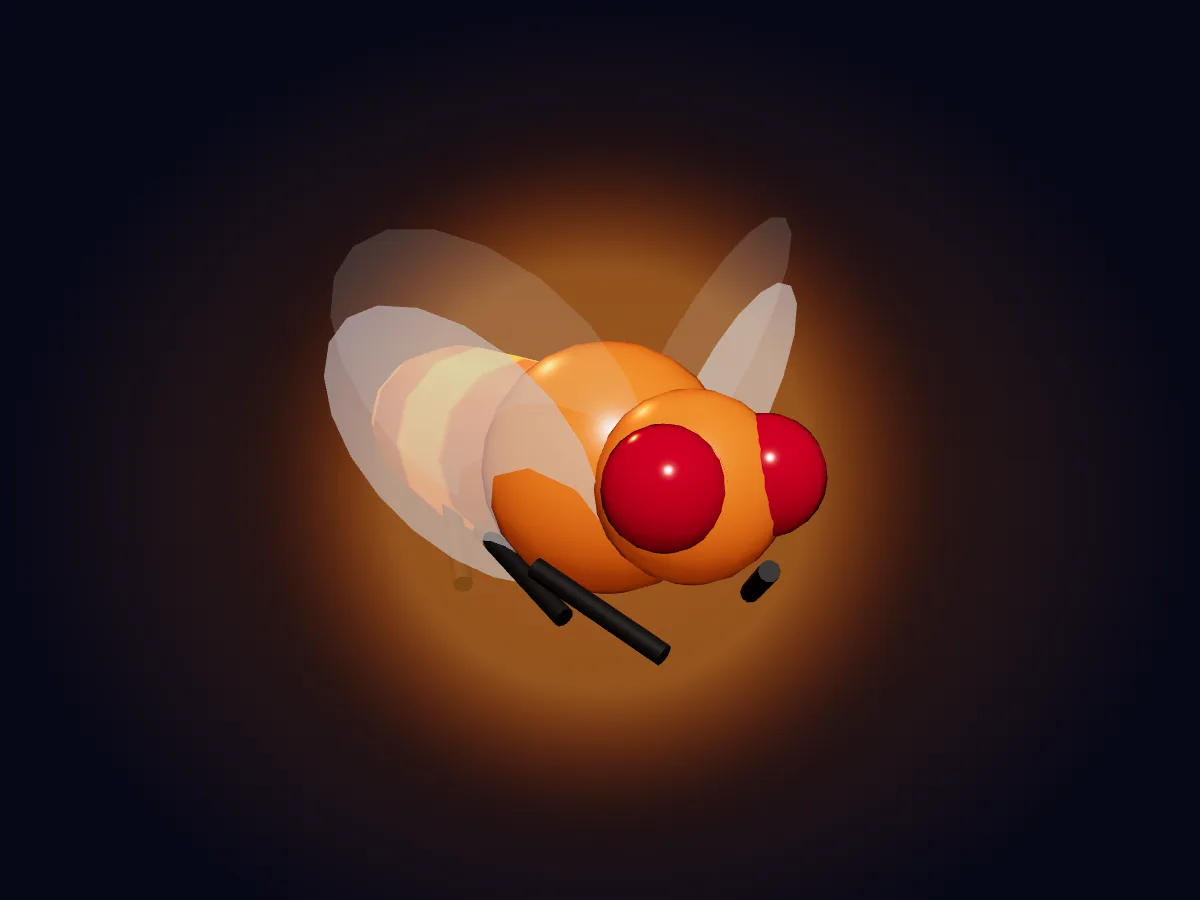
Direct
The focused all-rounder — at its best over a sprint or a mile, runs out of road in a marathon.
- Slow to recover when it clips a hazard
- Ignores food and light lures
The brain, firing
A simulated spiking brain: 293 neurons in four regions. Each region fires at a rate set by this fly's tuned dials, so a busier region means that fly leans on it harder. Illustration, not recorded data.
What each region does
- Optic lobesactivity 45
Sees hazards, rails and swooping hawks.
- Antennal lobesactivity 39
Smells lures and feels the wind.
- Central brainactivity 71
Weighs it all up and keeps the line.
- Descending / motoractivity 75
Turns the decision into turns and speed.
Skills
- Off the line60
How hard it goes in the opening stretch (early_pace). Bold spends its energy up front; Cautious saves it.
- Top speed79
Cruising drive (aggression) after the flat speed tax that high stamina costs.
- Endurance35
How slowly its energy drains over a long race (stamina). Low stamina visibly fades in a marathon.
- Late kick50
How much surge it has for the closing straight (finishing_kick).
- Hazard recovery17
How fast it shakes off a hit from a hazard (caution cuts the collision stun).
- Lure resistance95
How little food and light lures pull it off line (the inverse of distractibility).
- Wind handling45
How much of a gale's push it shrugs off (wind_resistance).
- Hawk reflex35
How strongly it dodges and bolts when a hawk swoops (fearfulness). Low means it barely reacts and even slows.
- Steadiness50
How clean its line is (the inverse of brain noise).
Tuned dials
Each fly runs the same simulated brain with its own hand-tuned settings. These are the raw numbers behind the bars.
- Early pace
- 0.60
- Aggression
- 0.85
- Stamina
- 0.35
- Finishing kick
- 0.50
- Caution
- 0.17
- Distractibility
- 0.05
- Fearfulness
- 0.35
- Wind resistance
- 0.45
- Brain noise
- 0.15
- Turn smoothing
- 0.30